From the Blog: Celebrating Our Brilliant SLPs During National Speech-Language-Hearing Month (Part II)
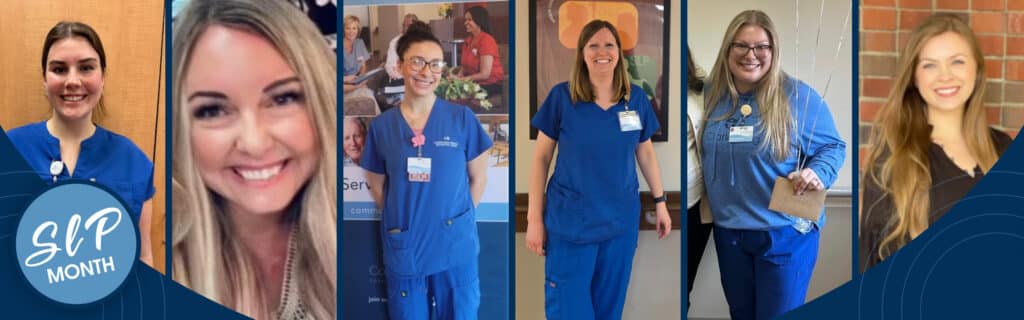
May is Speech-Language-Hearing Month, a time to celebrate the important work of speech-language pathologists (SLPs), especially those serving in our CommuniCare centers! To honor the dedicated SLPs making a difference every day, we spoke with six of our team members: Jenna Ferrebee from Crestview Manor Healthcare Center, Hannah Bird Harris from Clay and Charleston Healthcare Centers, Christie Heiner from Pebble Creek Healthcare Center, Jordan Mezzanote from Clarksburg Healthcare Center, Emma Harmon from Greenwood Healthcare Center, and Jennie Siri from Valley View Healthcare Center.
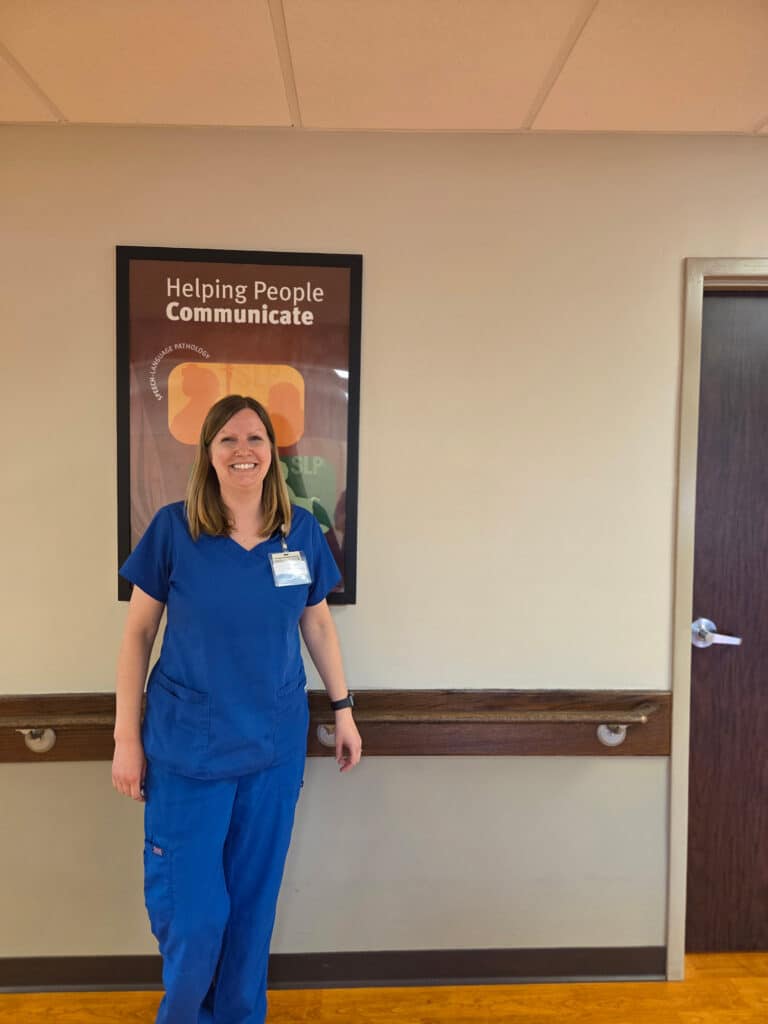
Where are you from and what facility do you work at?
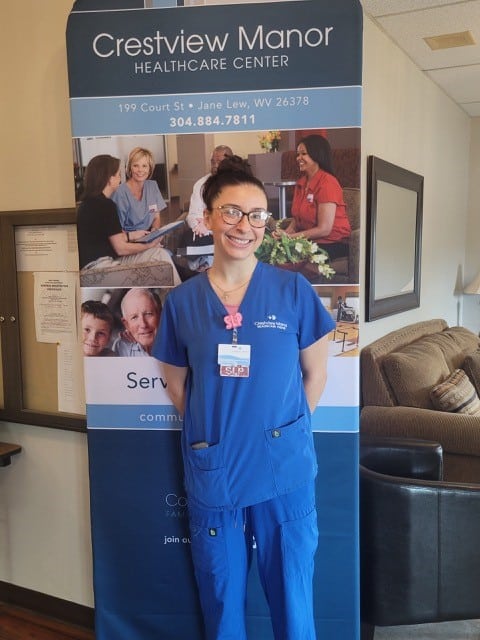
Jenna: I’m from New Martinsville, West Virginia, and work at Crestview Manor Healthcare Center!
Hannah: I’m from Charleston, West Virginia, and work at both the Clay and Charleston Healthcare Centers.
Christie: I’m from Lancaster, New York, and work at Pebble Creek Healthcare Center.
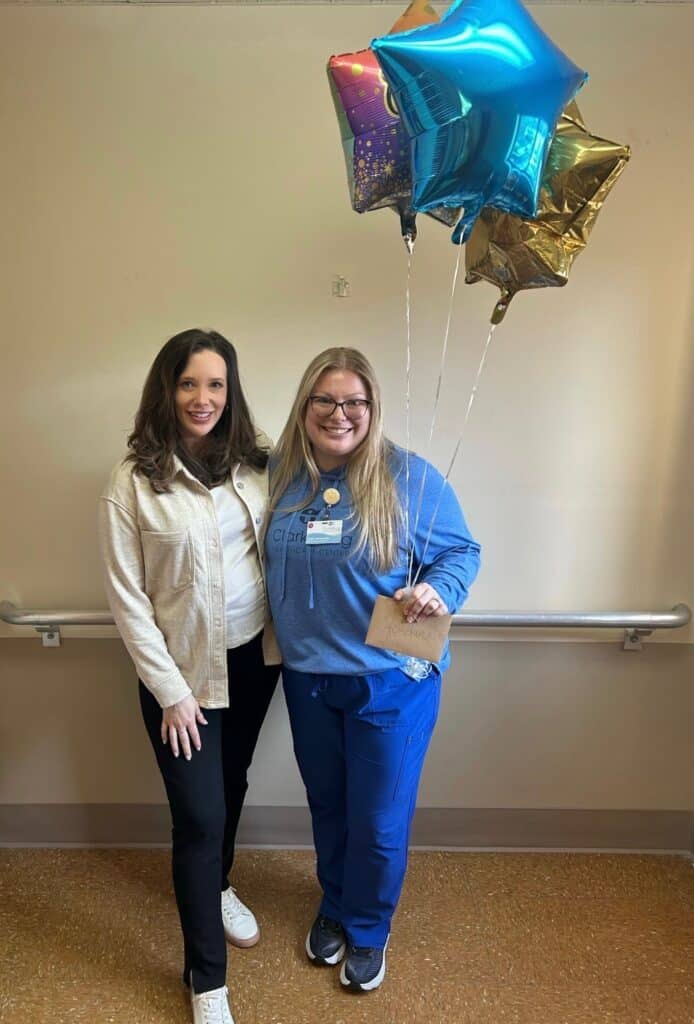
Jordan: I’m from Fairmont, West Virginia, and work at Clarksburg Healthcare Center.
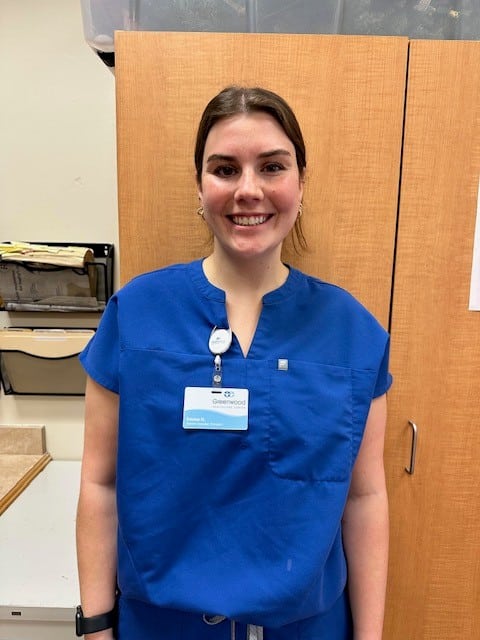
Emma: I work at Greenwood Healthcare Center and am from Indianapolis, Indiana.
Jennie: I am from Granger, Indiana, and work at Valley View Healthcare in Elkhart, Indiana.
How long have you been working as a speech-language pathologist and what drew you to this specific career path? Where did you receive your training?
Jenna: I’ve been working as an SLP for one year and studied at West Virginia University. In high school I wasn’t sure what I wanted to do and two of my cousins worked as SLPs in both a school and medical setting. I decided to shadow both of them and knew I would enjoy this career path!
Hannah: I’ve been working as an SLP for two and a half years and received my training from Marshall University. I was drawn to this career path after I took an online personality quiz my freshman year of high school. Speech therapy was my number one career match!
Christie: I studied at the State University of New York in Fredonia, New York, and have been in the field for 16 years. I’ve always been interested in the medical field and helping others!
Jordan: This career path picked me! I was originally a biology major, but I had a friend convince me to take an “Intro to Speech and Audiology” class and I loved it. I immediately switched my major halfway through the semester. I’ve now been working in the field for 11 months. I studied at West Virginia University!
Jennie: I have been working as a speech pathologist for 14 years. In my first career, I was an elementary school teacher. I have always wanted to work with people with disabilities. I was very close with my aunt growing up, who was diagnosed with cerebral palsy. I received my master’s degree in communication disorders from Western Kentucky University.
In your own words, how would you describe the role of an SLP?
Jenna: As SLPs, our role is to evaluate, diagnose, and treat individuals with swallowing, speech, language, voice, cognitive, and fluency disorders. This is done with people across the entire lifespan to help improve quality of life, overall communication abilities, and to improve functional skills performance throughout daily life.
Hannah: I typically say I’m a “professional problem solver.”
Christie: A professional who can assess, diagnose and treat communication, cognitive and swallowing changes.
Jordan: Difference maker!
Emma: I would describe the role of a speech-language pathologist as someone who helps individuals improve their communication and swallowing abilities — whether by restoring lost skills or adapting tasks and environments to support independence. Communication comes in many forms, and I believe everyone deserves the opportunity to express themselves in the way that works best for them, whether that’s through speech, gestures, or augmentative and alternative communication methods.
Jennie: Most people think that speech pathologists only work on ‘speech’ but our roles are so diverse. We address cognition, learning difficulties related to language, voice disorders, dysphagia (swallowing disorders), fluency, and speech disorders. I have always said our profession needs a different title!
What is your favorite part of being an SLP or working in the skilled nursing/long-term care space? What keeps you passionate about your work?
Jenna: I really enjoy working in the skilled nursing and acute care setting because I am able to build stronger and more meaningful relationships with my patients to help them reach their desired goals with treatment. Compared to a more acute care setting, I am able to really see the impact of therapy on their daily lives.
Hannah: I love seeing people become more sure and confident in themselves as their independence grows, and helping them return to their community!
Christie: Seeing patients meet their goals!
Jordan: Seeing the joy on the residents’ faces when they get to experience eating an upgraded diet for the first time or when they are able to tell a family member “I love you” post stroke.
Emma: My favorite part of being an SLP is seeing patients reach their goals and overcome obstacles during their treatment journey. I enjoy collaborating with other therapists and providing patients with the most functional methods of treatment to promote carry-over into their lives outside of therapy.
Jennie: My favorite part of working in a skilled nursing facility are the residents! I love being a bright light in their day.
Can you describe a moment or experience in your career that made you feel especially proud or fulfilled?
Jenna: Building a relationship with one of our long-term care residents who has refused to participate in therapy and additional leisure activities in the nursing unit has been very meaningful. I have been able to work with her throughout our duration of therapy to increase time spent with other residents, participation in activities, and improve overall engagement and willingness to participate in therapy.
Hannah: Helping a patient with severe aphasia restore her ability to talk and be able to tell her son she loved him again.
Christie: Having a family member of a patient who has dementia thank me for helping her father, teaching family strategies to help care for a patient at home, and bringing a smile back to him.
Jordan: When my seventh month “nothing by mouth” patient was given their first lunch trial tray after their FEES test.
Jennie: My favorite or most rewarding moments are the patients that I have successfully weaned from feeding tubes to full oral diets.
What is the most rewarding part of working with residents and patients in your current facility?
Jenna: Getting to see improvement in both short-term and long-term patients and working with them to meet their desired goals throughout all disciplines.
Hannah: I love forming relationships with the patients and letting them know they have an advocate and someone who wants to help them meet their full potential.
Christie: Working with short- and long-term residents. I see them succeed in different ways from communication, memory and swallowing.
Jordan: The joy on my patient’s/families faces when we pass each other in the hallways even after they are discharged from therapy.
Jennie: I love the patients at Valley View. I have worked with so many of them and feel like they are all a part of our therapy family here. My favorite part of my job is hearing their stories and about their lives before they came here.
What do you enjoy doing in your free time when you’re not working?
Jenna: After work I am usually at the gym, weightlifting, or taking cycle classes. On the weekends, a majority of my free time is spent at concerts, reading, watching reality game shows (Survivor, Big Brother, The Challenge, and Love Island) and hanging out with my best friend’s and dog.
Hannah: I enjoy thrifting and tending to my plants and dogs. I also love to cook and bake!
Christie: I enjoy spending time with my son and watching him play baseball. I enjoy being with my husband and step kids when I am not at work. I love to belly dance and read fiction novels.
Jordan: I love hanging out with my family, fiancé, and dog whenever I’m given the chance…and shopping!
Emma: When I am not working as an SLP I enjoy working out, reading, and playing golf with my fiancé.
Jennie: I have four kids, so I don’t have a lot of free time! I really enjoy watching my kids play sports. My boys play travel baseball, and my daughter is a competitive gymnast. Meets and tournaments take up a lot of our weekends! When I do get time to myself, I love to read. I make it a goal every year to read at least 1 book per month.
Can you share something fun or unique about yourself that most people wouldn’t know?
Jenna: I have seen over 80 different bands and singers perform live in concert.
Hannah: I enjoy singing and acting in local community theater shows.
Christie: I continue to belly dance weekly with a friend. We were in a dance troupe together in previous years. Now we dance just for fun! I also taught my dog Odie to “say” hello!
Jordan: I’ve been a certified scuba diver for over 10 years.
Jennie: I have three dogs! We have an eight-year-old goldendoodle, a two-year-old cavapoo, and a four-month-old cavapoo. I would get three more if it didn’t feel crazy! I’m also an extremely fast reader. My parents used to joke they were going to enter me into speed reading contests when I was younger!
What would you want people to know about speech therapy as a profession, especially as we celebrate Speech-Language-Hearing Month in the nursing home space?
Jenna: It is common for patients, caregivers, and some staff members to be confused on the entire role of an SLP in the nursing facility. In this setting, working with an SLP goes beyond what people typically view as “speech therapy.” As therapists, we can play an important role in overall communication with staff, caregivers, and other residents, support cognitive functioning for everyday tasks and daily activities, and target overall swallowing function to improve patients’ ability to safely and effectively eat. Working in a setting like this also often involves collaboration with other staff outside of rehab services, like nursing and dietary departments, to develop and create a comprehensive care plan for each individual.
Hannah: We are always happy to thicken liquids and assist with oral secretions to save our coworkers who may get queasy.
Christie: It is a rewarding profession in which we help better the lives of our patients and associated caregivers.
Jordan: That it is equally as important to be able to eat, drink and order your own meal at a restaurant as it is walking into the restaurant. It is equally important to be able to identify your room as it is to walk/wheel to it. The job of a Speech-Language Pathologist is far wider and more in depth than most people know. The field SLP is an umbrella term for individuals 0-100 years old covering articulation, stuttering, language, voice, social skills, memory, swallowing, cognition and communication. We do not “just teach people how to talk.”
Emma: I think it is important that people understand the full scope of SLPs, and that treatment is not limited to “talking” and “speech” like the name suggests. Speech therapy encompasses many more domains such as cognitive linguistic skills, social communication, motor speech, dysphagia, augmentative and alternative communication, articulation, voice, expressive and receptive language, and much more. I feel blessed to work with the many patients I have encountered while working at CommuniCare and look forward to the further impact I may have on our residents here at Greenwood Healthcare.
Jennie: I would want people to know that speech pathology is such a great profession because we get to work with such a wide variety of ages, disorders, and settings!